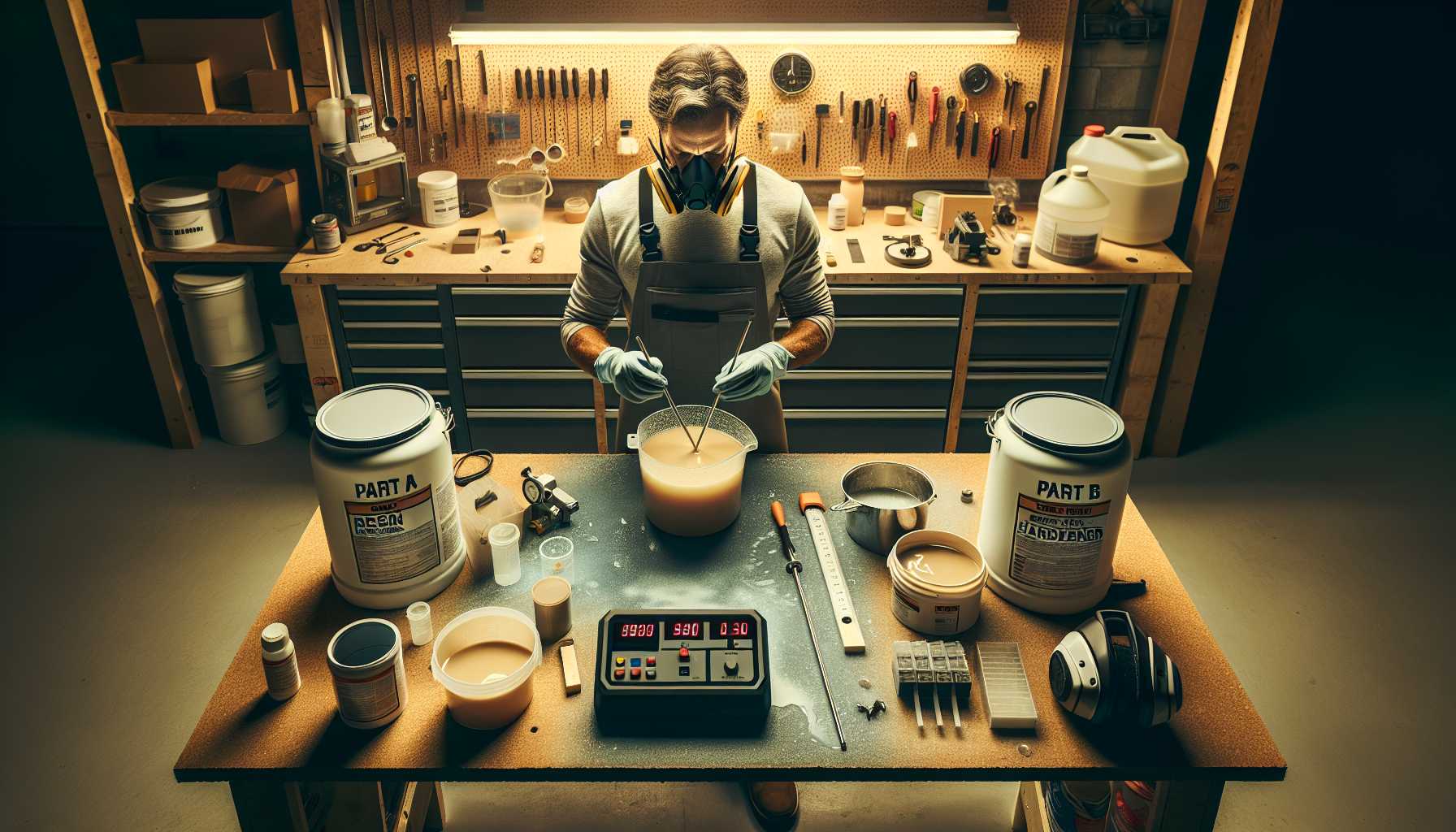
Ever been in your garage with a blank stare, clueless about epoxy paint ingredients and how to mix them correctly? Don’t worry, you’re not the only one! Here’s a straightforward guide to simplify the process for you.
The Basics of Epoxy Paint Components
Consider the epoxy paint as you would baking a cake – you require the correct ingredients in precise proportions. You’ll have:
– Part A: The Resin (think of it as your cake base)
– Part B: The Hardener (similar to the catalyst in a reaction)
– Supplements (much like sprinkles on a cake, these are optional!)
Accurately Assessing the Ratio
A fundamental rule to keep in mind: Usually, epoxy paints need a 1:1 proportion, but don’t just take my word for it! Always:
– Confirm with your producer’s guidelines
– Use measuring utensils or containers
– Keep in mind, haphazard estimates won’t work here
Timing Is of the Essence
Racing against curing epoxy can be stressful! Here’s an essential point to remember:
– Stir for precisely 2-3 minutes (no more and no less)
– Use within the stipulated pot life (generally given as 30-45 minutes)
– Plan your task beforehand
Common Blunders To Steer Clear of
Even the best of us have made these mistakes! Here’s what to avoid:
– Stirring too quickly (leads to bubbles)
– Using unclean utensils
– Overlooking the temperature prerequisites
– Using expired products
Paying Heed to Temperature and Surroundings
Your workspace is more than just an area – it’s an integral part of the process:
– Optimal temperature: 65-80°F (18-27°C)
– Maintain humidity below 85%
– Assure ample ventilation
– Preserve components at room temperature
Expert Advice for Optimal Outcomes
Here are a few personal tips I’ve learned the hard way:
– Employ a drill mixer for large quantities
– Remember to scrape the sides during stirring
– Stir in a well-illuminated surroundings
– Have a timer close by
Safety is Paramount!
Your safety is more essential than mastering the epoxy:
– Don protective gloves
– Wear a respirator mask
– Ventilate the space you’re working in
– Keep cleaning equipment available
When Situations Go South
Don’t fret if you encounter issues! Even experts falter sometimes. Here’s what to consider:
– Are there sticky patches? It’s due to improper mixing
– Not setting properly? Your ratios might be off
– Finding bubbles? You’ve stirred too robustly
– If there’s color disparity, the mixing wasn’t adequate
Final Remarks
Remember that mastering the art of mixing epoxy is akin to learning to ride a bicycle – it’s all about practice! Start with minor tasks and gradually take on larger projects. You can do this!
Commit these tips to memory, and soon you’ll be proficient at mixing epoxy paint! Happy mixing!
If you need more tailored advice, do not hesitate to ask your queries in the comments section. I’m always available to assist you!